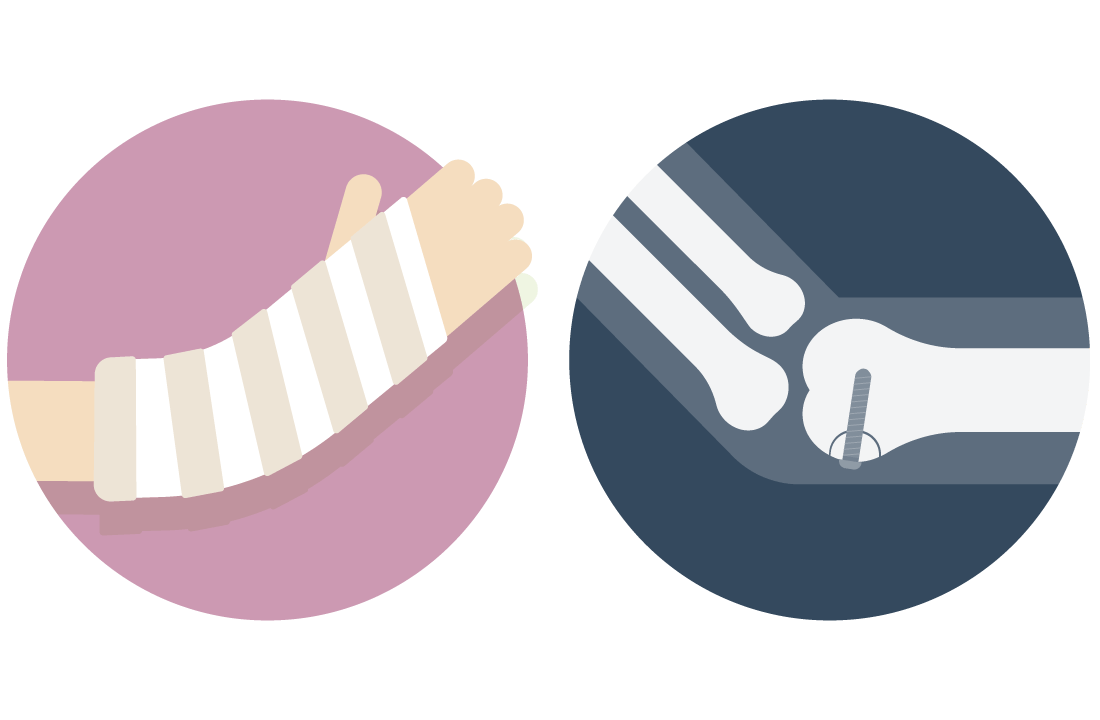
SCIENCE animation
A medial epicondyle fracture is a break on the inner side of the elbow where a small piece of bone gets damaged.
Every year, thousands of children around the world have this type of fracture.
In the past, doctors treated it in different ways.
Some used a cast, allowing the bone to heal on its own. Others performed surgery, fixing the bone with screws or wires.
However, families want to feel confident that surgery will really benefit their child before going ahead.
To find out if surgery was better than a cast researchers carried out the SCIENCE Study - short for Surgery or Cast for Injuries of the Epicondyle in Children’s Elbows.
The study involved 334 children aged 7 to 15 from the UK, Australia, and New Zealand.
All had a displaced medial epicondyle fracture.
A quarter had a particularly severe injury, where the elbow was initially dislocated.
The SCIENCE Study was a randomised trial.
This means each child had an equal chance of receiving either treatment.
The decision was made by chance (at random) – rather than by families or doctors – to make the comparison fair and ensure the results are trustworthy.
Half of the children wore a cast for four weeks, while the other half had surgery to fix the bone with screws or wires.
During their recovery, children and families were asked about pain, how well they could use their arm, how many hospital visits they had, and how much school they missed.
The results showed that both treatments worked just as well - surgery did not lead to better recovery.
Children had similar levels of pain, used their arms in the same way and got back to sport as quickly.
However, using a cast meant fewer operations, fewer complications, fewer days of school missed, and lower costs for families and the health system.
So, for children with this kind of elbow fracture, wearing a cast is just as effective as surgery - and comes with fewer risks, more school and lower costs.